
Master the Math: How to Calculate Torque Wrench Settings for Scuba Regulators
Precision is everything in mechanical work. Tighten a fastener too little, and it shakes loose; tighten it too much, and you risk stripping threads or snapping bolts. A quality torque wrench ensures accuracy, but the moment you add a crowfoot adapter or an extension that alters the length of the tool, the calibration on the dial no longer matches the force applied to the fastener.
Here is exactly how torque wrench physics changes with adapters, and how to calculate the correct setting for scuba regulators in both Newton Metres (Nm) and Imperial units.
Why Scuba Tool Adapters Change the Math
A torque wrench is a lever calibrated to click or alert you when a specific force is achieved at its drive square. When you attach an adapter (like a crowfoot) straight out in line with the wrench, you lengthen that lever arm.
Because you have increased your mechanical advantage, the actual torque applied to the bolt will be higher than the setting on the wrench scale. To avoid over-tightening, you must calculate a reduced wrench setting.
The 90-Degree Exception: If you attach your adapter at a strict 90-degree angle to the wrench body, the effective lever-arm length does not change. In this specific layout, no mathematical adjustments are required—the torque set on the wrench equals the torque applied to the fastener.
The Universal Adjustment Formula
To find your required torque wrench setting, use the following universal formula:

Where:
T (Target Torque): The final torque specification required for the fastener.
L (Effective Wrench Length): The distance from the center of the handle grip (where your hand applies pressure) to the center of the wrench’s square drive.
A (Adapter Length): The distance from the center of the wrench's square drive to the center of the fastener head.
Step-by-Step Practical Examples
Example 1: Calculating in Metric (Newton Metres - Nm)
Imagine you are working on a first stage. Your workshop manual calls for a target torque (T) of 60 Nm.
Your Tools: Your torque wrench length (L) is 300 mm (0.3 metres). Your straight inline adapter (A) adds 50 mm (0.05 metres).
The Math:

The Result: Set your torque wrench to 51.4 Nm. When the wrench clicks at 51.4 Nm, the extended leverage ensures the bolt receives exactly the required 60 Nm.
Example 2: Calculating in Imperial (Foot-pounds - ft-lb)
Now let's look at a manual using imperial measurements. Your target torque (T) is 120 ft-lb.
Your Tools: Your torque wrench length (L) is 18 inches. Your straight inline adapter (A) adds 3 inches.
The Math:
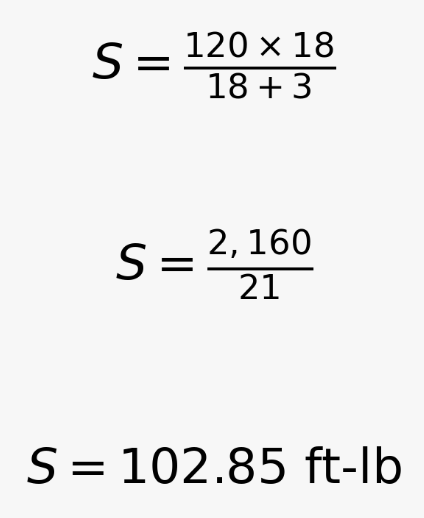
The Result: Set your torque wrench dial to 103 ft-lb to correctly achieve 120 ft-lb at the fastener.
Top Tips for Flawless scuba regulator torque wrench settings
Keep Measurements Consistent: Ensure (L) and (A) use the same units (both in millimetres, both in metres, or both in inches) before running the equation.
Mind Your Hand Placement: Place your hand precisely in the middle of the manufactured handle grip. Choking up or holding the wrench too far back alters the (L) value and voids your calculation.
Pull Smoothly: Apply a slow, steady force. Jerking or popping the wrench applies sudden dynamic kinetic energy that over-tightens the bolt past the click.
Wind Down to Zero: When your job is finished, always wind your mechanical torque wrench back down to its lowest graduation mark to preserve spring calibration during storage.
Diving on Demand / Scuba Service Tools accepts no liability for the information given in this document.
Our documents are to provide a general understanding of SCUBA diving-related topics, and not to provide specific advice.
Most authorised dealers can perform warranty, repair, and service work on your equipment. Availability of sub-assemblies and components, repair parts, specialised tools, maintenance guides, and service manuals does not imply qualification to assemble and service scuba equipment. Improper service of dive equipment can lead to serious injury or death.